
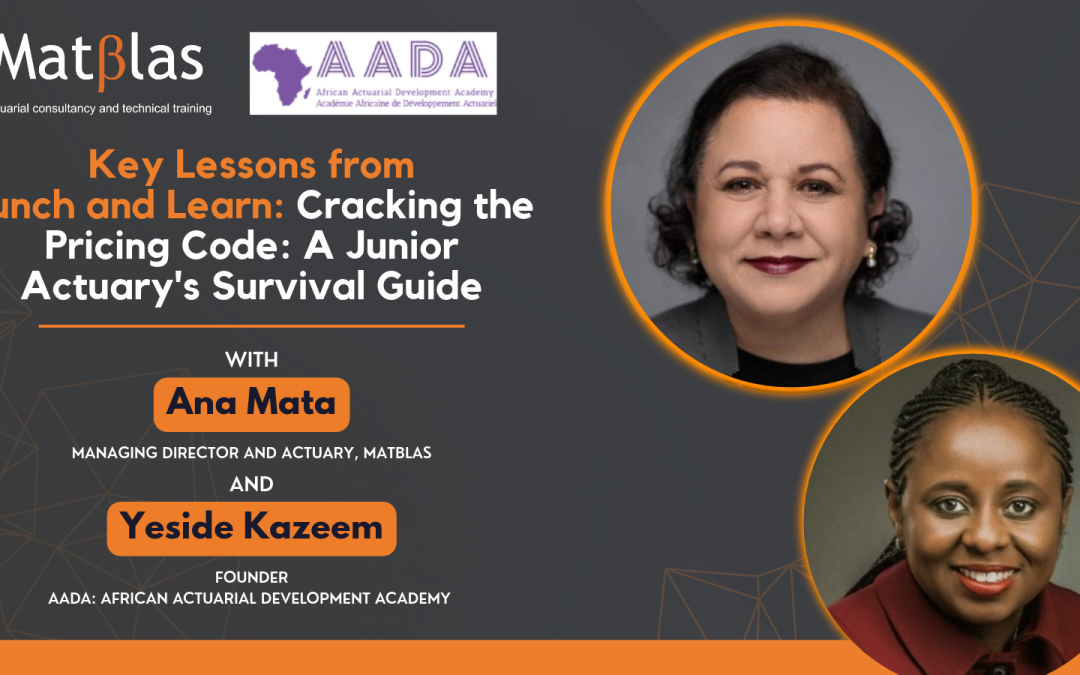
On 13 October 2026, MatBlas Founder and Managing Director Dr Ana Mata PhD, ACAS, joined the African Actuarial Development Academy (AADA) to deliver an online Lunch & Learn exploring the fundamentals of non-life insurance pricing.
Titled Cracking the Pricing Code: A Junior Actuary’s Survival Guide, the session was designed primarily for actuarial practitioners with one to five years of experience, providing an opportunity to strengthen their technical understanding and explore how pricing principles are applied in practice.
The event attracted strong interest from across the actuarial community, with approximately 65 participants attending at one point during the session. The audience also included more experienced actuaries, demonstrating the wider relevance of the discussion.
Moderated by Yeside Kazeem, one of AADA’s founders, the session explored the relationship between pricing, underwriting, reserving, capital and data, alongside the importance of developing consistent technical pricing frameworks.
Why insurance pricing is about more than calculating premiums
One of Ana’s central messages was that pricing sits at the beginning of the insurance underwriting cycle.
When an insurer prices a policy, it is estimating the future cost of claims, alongside the expenses, reinsurance costs and capital requirements needed to support that risk.
However, the actual cost of claims may not become known for several years. For long-tail classes of business, the final outcome can take considerably longer to emerge.
This creates an important challenge for pricing actuaries: decisions must be made today using assumptions about future events that cannot yet be fully validated.
Ana emphasised that consistency is therefore one of the most important qualities of an effective pricing process.
A consistent framework allows insurers to monitor performance, compare results and gradually test whether the assumptions made at the point of underwriting reflect actual experience.
Understanding the relationship between loss cost and premium
The session also explored an important distinction between estimating the expected cost of claims and calculating the premium required to insure a risk.
Actuarial techniques such as experience rating, exposure rating and predictive modelling can help estimate expected loss costs.
However, estimating those costs is only part of the pricing process.
To arrive at a premium, insurers must also consider expenses, brokerage, reinsurance arrangements, capital requirements and their target profitability.
Ana demonstrated how different business objectives, such as targeting a particular loss ratio or return on capital, can produce different premiums for the same underlying risk.
This is particularly important for junior actuaries developing their understanding of how technical analysis connects with commercial decision-making.
Building consistent technical pricing models
Another key area of discussion was the design of technical pricing models.
Ana explained how a structured pricing framework should account for differences in risk characteristics, including:
- The size and nature of the insured business
- Industry sector and geographical exposure
- Policy limits, deductibles and coverage
- Risk management characteristics
- Brokerage and other relevant costs
The session also explored differences between property and liability pricing, including the use of exposure curves and increased limit factors when allocating premiums across different levels of coverage.
A consistent approach helps ensure that similar risks are assessed using comparable assumptions, while allowing appropriate adjustments for individual risk characteristics.
It also creates a clearer record of how pricing decisions have been reached.
Why data collection matters
Throughout the session, Ana returned to the importance of collecting and retaining useful pricing information.
Insurance businesses generate significant amounts of data through submissions, claims histories, exposure information and underwriting decisions.
However, when that information remains scattered across spreadsheets, documents and disconnected processes, it becomes difficult to use effectively.
For pricing teams, the value of data extends beyond the immediate calculation.
Consistently capturing exposures, assumptions, technical premiums and agreed premiums creates opportunities to monitor performance, analyse rate changes and improve models over time.
Ana also highlighted the importance of distinguishing between observed facts and assumptions about future outcomes.
Historical claims data provides valuable evidence, but pricing actuaries must still exercise judgement when considering inflation, claims development, emerging risks and events that may not yet have appeared in historical experience.
Pricing is only one part of effective risk management
As the presentation drew to a close, Ana highlighted another important consideration: even a well-designed pricing model cannot replace effective portfolio and risk management.
Portfolio diversification, exposure management and capital considerations all influence an insurer’s ability to achieve sustainable results.
For junior actuaries, understanding these connections is an important part of developing a broader perspective on the insurance business.
Pricing does not operate in isolation. It forms part of a wider cycle in which underwriting decisions, claims experience, reserving, capital and portfolio management are closely connected.
A valuable discussion with the African actuarial community
The Lunch & Learn generated considerable engagement, with attendees asking questions throughout the session.
AADA subsequently shared positive feedback and noted that several questions remained unanswered due to time constraints.
There was also interest in exploring additional topics, including data, cyber risk and parametric insurance, through potential future sessions.
MatBlas would like to thank Yeside Kazeem, Yvonne Palm and the wider AADA team for organising the event and inviting Ana to share her experience with actuarial professionals across Africa.
Supporting technical education and professional development remains an important part of MatBlas’ work, and we were pleased to contribute to AADA’s efforts to develop the actuarial profession across the continent.
Watch the full Lunch & Learn
For those who were unable to attend, or who would like to revisit the technical examples and discussions, the full recording is available on AADA’s YouTube channel.
Watch Cracking the Pricing Code: A Junior Actuary’s Survival Guide:
https://www.youtube.com/watch?v=sLENEBIuAFA

Ana Mata
Managing Director and Actuary
Recent Comments